

 English
 中文简体
 русский
 Español
 عربى


Industry News
Pellet Mill Pressure Roller: Materials, Clearance, and Replacement Timing
The operator of a 350 kW ring-die pellet line watches output drift from 12 t/h to 9.6 t/h across six weeks. The die is clean, conditioning temperature is stable, and motor load is normal. The fault is on the roller side: all three pellet mill pressure rollers have flat spots, and the compression gap has turned into a slipping zone. That failure sequence explains a large share of sudden output losses in feed mills.
A pellet mill pressure roller is a wear component with a measurable service life, and choosing it is not a generic parts order. Feed formula, shell profile, shell material, and mounting clearance each change roller life by a factor of two or more. Anhui Jindingsheng Machinery Co., Ltd. builds roller shells, pressure roller assemblies, eccentric shafts, and internal components for pellet mills, and the decisions below are the ones its engineers see repeated most often in maintenance budgets.
Content
- 1 What a Pellet Mill Pressure Roller Does During Compression
- 2 Three Wear Patterns That Expose Pellet Mill Pressure Roller Problems
- 3 Pressure Roller Shell Materials: Hardness vs Toughness
- 4 Matching the Roller Shell Profile to the Feedstock
- 5 Roller Clearance Settings and the Maintenance Schedule
- 6 When a Pellet Mill Pressure Roller Assembly Is the Faster Replacement
- 7 Pellet Mill Pressure Roller FAQ
- 7.1 How often should a pellet mill pressure roller be replaced?
- 7.2 What is the correct roller-to-die clearance on a pellet mill pressure roller?
- 7.3 Can a worn pellet mill pressure roller shell be hardfaced and reused?
- 7.4 What hardness should a pressure roller shell have for feed pellets compared to wood pellets?
What a Pellet Mill Pressure Roller Does During Compression
A pellet mill pressure roller transfers the die's friction into radial compression that pushes conditioned mash through the die holes. Ring-die machines carry two or three rollers on fixed eccentric shafts, and each pass through the nip generates local pressures near 300-500 MPa. At surface speeds around 5-7 m/s, that pressure densifies feed, wood, or fertilizer into pellets.
The roller is attacked by abrasion and fatigue at the same time. Mineral grit scores the face, and repeated cyclic load peels the surface. A feed formula that contains only 2-3% sand or silica can cut shell life by more than half. This is why material selection comes before every other maintenance action.
Before blaming the roller part, confirm three operating conditions:
- Clearance: a gap bigger than 0.3 mm triggers sliding contact and heat buildup.
- Full contact: shell diameter differences above 1 mm across the width alter the pressure profile.
- Bearing seats: play in the eccentric shaft or roller bearing creates knocking on the shell edge.
Three Wear Patterns That Expose Pellet Mill Pressure Roller Problems
Each wear pattern on a pressure roller shell points to a specific root cause. Reading the pattern correctly tells a maintenance team which material to order next, and which operating fault to correct first.
| Pattern | Visual sign | Root cause | Typical fix |
| Abrasive scoring | Fine parallel grooves in the rolling direction | Sand, silica, or recycled fines in the mash | Move to GCr15/100Cr6, hardness above 58 HRC |
| Flat spotting | Polished facets that flatten the shell curve | Clearance too tight or shell too soft for the load | Reset clearance to 0.1-0.3 mm; consider 40Cr |
| Spalling | Small pits that grow into craters | Fatigue cycling, surface hardness outrunning core support | Use carburized 20CrMnTi for a stronger case-core system |
| Edge chipping | Broken edges at the shell corners | Bearing play or roller set misalignment | Inspect eccentric shaft and bearing seats first |
Spalling is the failure that follows a hardness upgrade. A mill that moves from 40Cr to GCr15 without checking bearing condition sometimes sees pits appear within weeks: a very hard shell without core support cannot absorb shock. Carburized 20CrMnTi exists precisely for that combination of abrasion and impact.
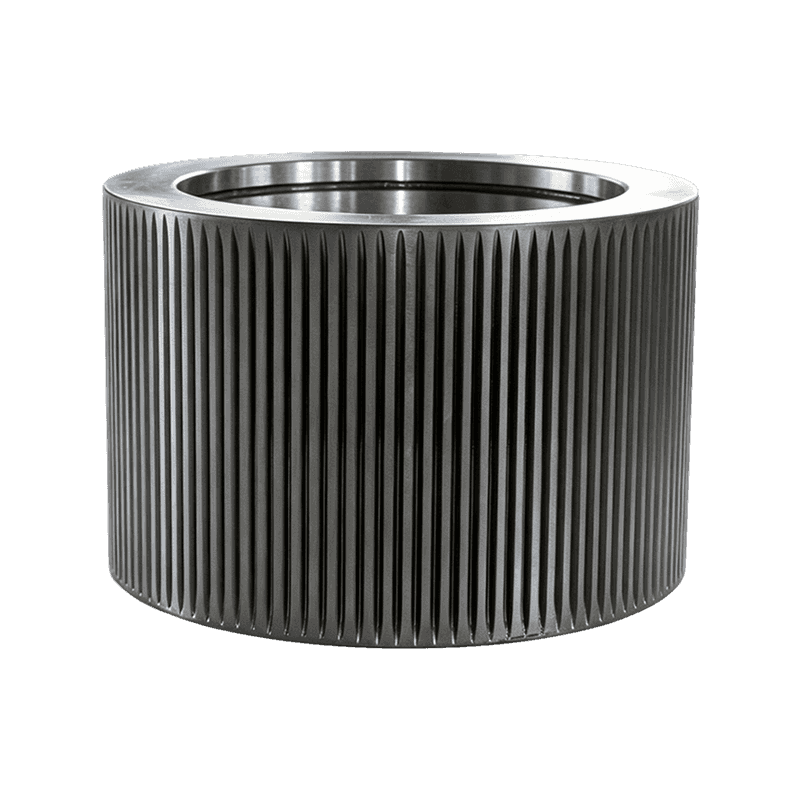
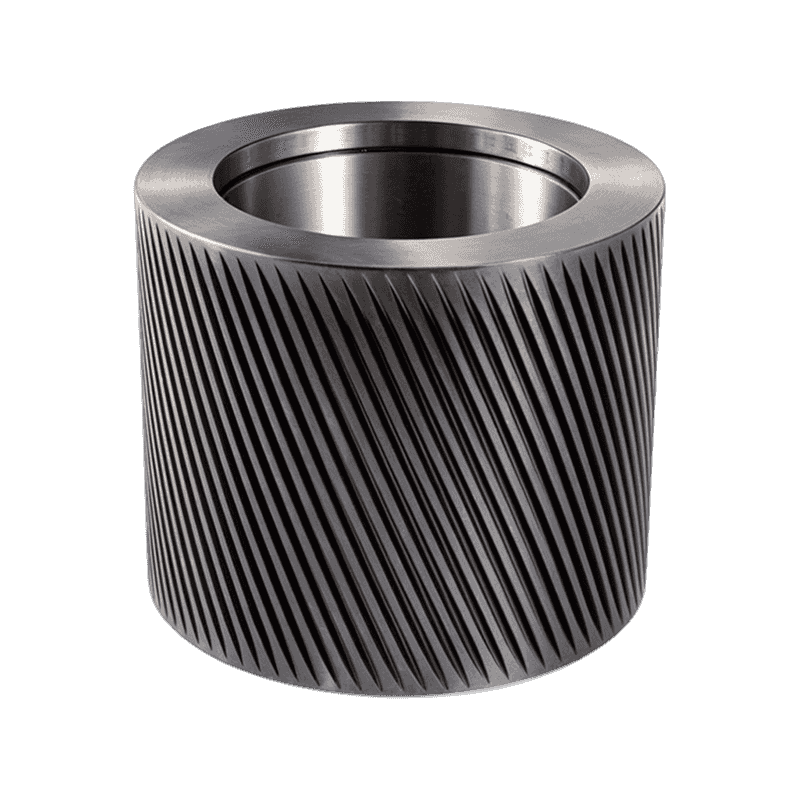 GCr15/100Cr6 Bearing Steel Pellet Roller Shell for High-Abrasion DutiesThis roller shell uses high-carbon chromium bearing steel for maximum surface hardness, making it a strong choice when abrasion outweighs impact in demanding pelletizing conditions.View Product →
Pressure Roller Shell Materials: Hardness vs Toughness
Shell life is a trade-off between surface hardness and core toughness. Through-hardened GCr15/100Cr6 resists abrasion best, carburized 20CrMnTi is the best compromise for shock-loaded mills, and 40Cr remains the default for general feed duty.
| Steel grade | Surface hardness | Relative life | Best fit |
| 45# carbon steel | 45-52 HRC | 1.0x | Low-cost replacement, non-abrasive mash |
| 40Cr alloy steel | 52-56 HRC | 1.4x | General feed mills, corn-soy rations |
| 60Si2Mn spring steel | 45-50 HRC | 1.2x | Impact-heavy work, strongly varying loads |
| 20CrMnTi carburized | 58-62 HRC | 1.8x | Abrasive feed with shock loads |
| GCr15/100Cr6 | 58-62 HRC | 2.2x | Clean but abrasive rations |
Life indexes are relative shop-floor comparisons under similar clearance and formula conditions; they are not guaranteed ratings.
Wood pellet lines change the calculation. Sawdust carries silica from bark and field grit, so many wood pellet operators choose 20CrMnTi or GCr15 surfaces even when the die is the same size as a feed die.
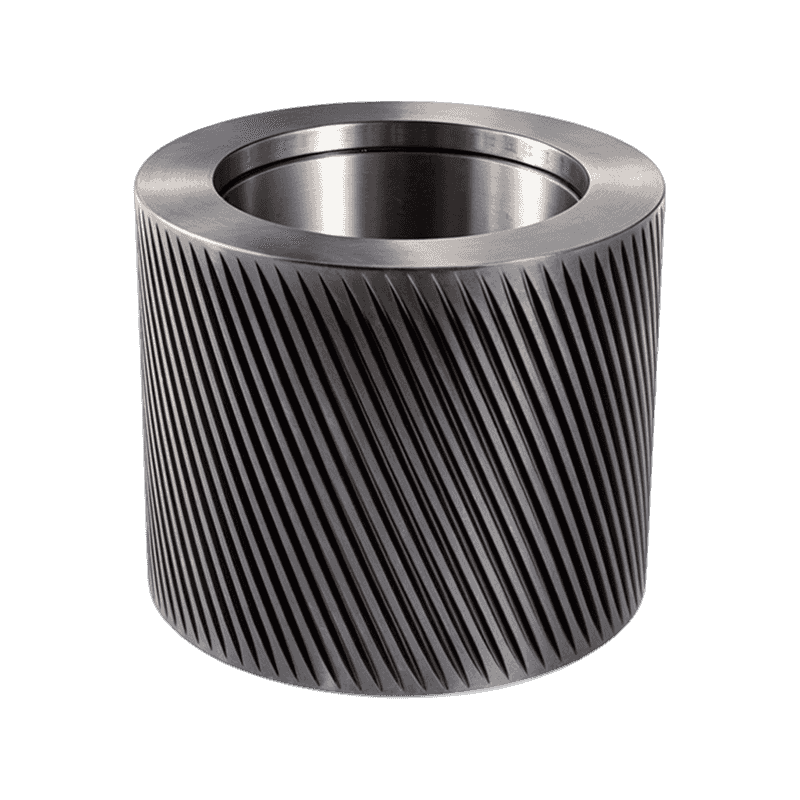
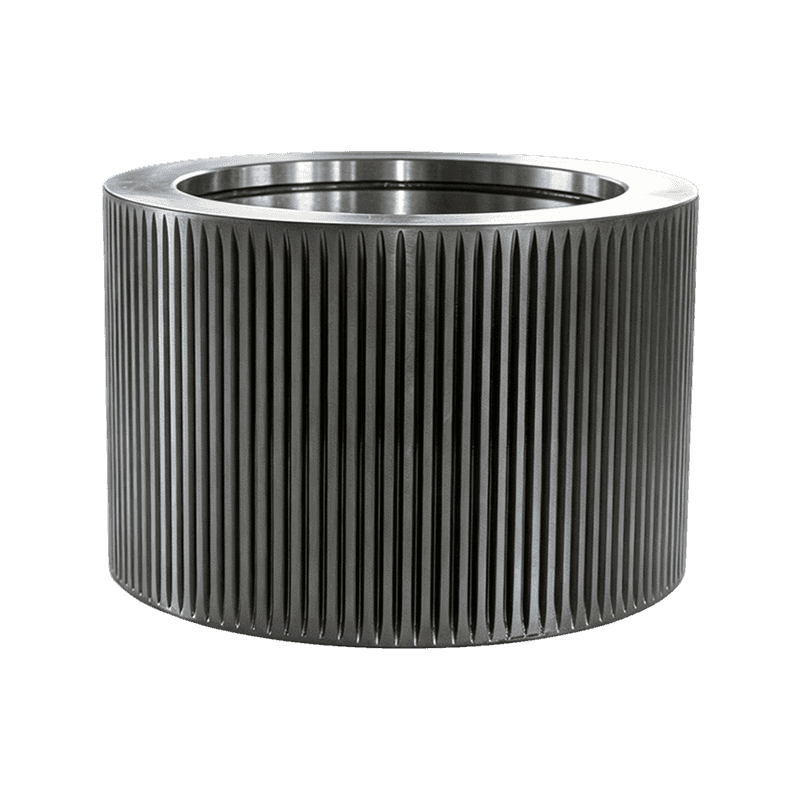 40Cr Alloy Steel Pellet Roller Shell with Multiple Tooth ProfilesA versatile, cost-effective roller shell available in straight, helical, arc, or hole patterns, suited for biomass and feed lines that need dependable general-duty performance.View Product →
Matching the Roller Shell Profile to the Feedstock
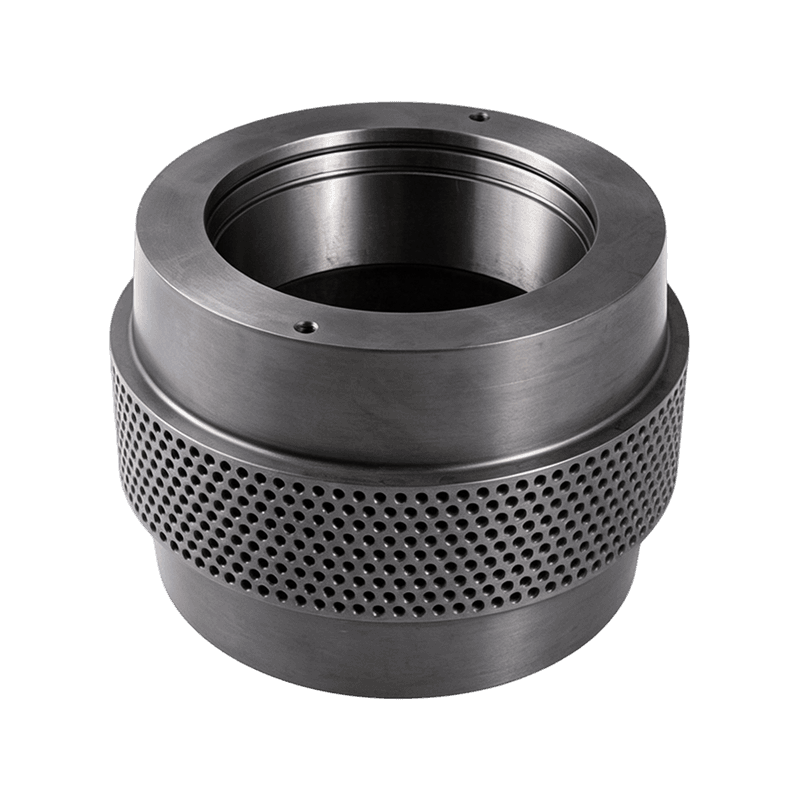
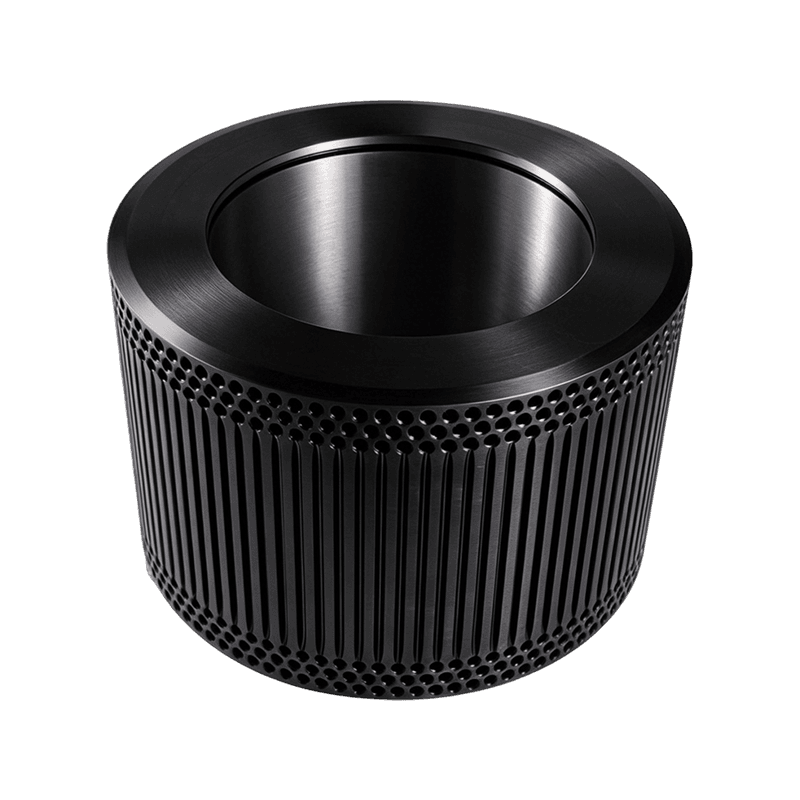
The shell profile controls how the mash is pulled into the nip. Straight corrugated roller shells grip fibrous mash, a dimpled surface compresses gently, and a curved-tooth shell improves bite on fine, mealy ingredients. There is no universal best profile, only a pairing decision between roller surface and die specification.
- Corrugated profile: best for bulky, fibrous materials such as straw and hay; improves material intake.
- Dimpled profile: lower compression shock, suited to oily and heat-sensitive feed formulas.
- Curved-tooth profile: secure grip with less slip, good for fine ground mash and wood.
- Closed-end shells protect the roller sides on abrasive duty; open-end shells clean faster and suit soft formulas.
Check shell width and taper fit against the original assembly drawing before ordering. A roller that does not touch the die across its full width creates a pressure stripe, which produces die wear in a narrow band.
Roller Clearance Settings and the Maintenance Schedule
Roller-to-die clearance is set with the mill stopped: the roller must touch the die along the full width, then be backed off by 0.1-0.3 mm. More clearance causes slip, and less clearance flattens the roller and overloads the die.
Daily startup
Turn the die by hand, listen for metal contact, and check the roller face after the first minutes of load.
Every 200 hours
Measure the shell diameter at both edges and the middle; record flat spots in millimeters.
Every 300-500 hours
Check bearing play and eccentric shaft condition before fitting new shells.
Every 600-800 hours
Rotate or replace shells based on the measured wear trend, not on a calendar guess.
This schedule is a practical minimum for a feed mill running two shifts. In a 12 t/h plant, roller inspection costs a few hours of labor; an unplanned failure costs a die replacement and five-figure downtime.
When a Pellet Mill Pressure Roller Assembly Is the Faster Replacement
Replacing only the shell is cheaper on paper, but a complete pressure roller assembly is often the rational choice when bearings, seals, and shaft seats are also near end of life. The labor difference is large, because exchanging an assembly avoids pressing off the old shell and pressing on a new one.
Shell-only replacement
- Lower component cost
- 4-6 hours of teardown and press work
- Second teardown risk if bearings are worn
Complete pressure roller assembly
- Higher component cost
- 1-2 hours of exchange work
- Single maintenance window with a known end state
A 24/7 line usually makes the assembly choice. The extra component cost is smaller than the value of the first hour of avoided downtime.
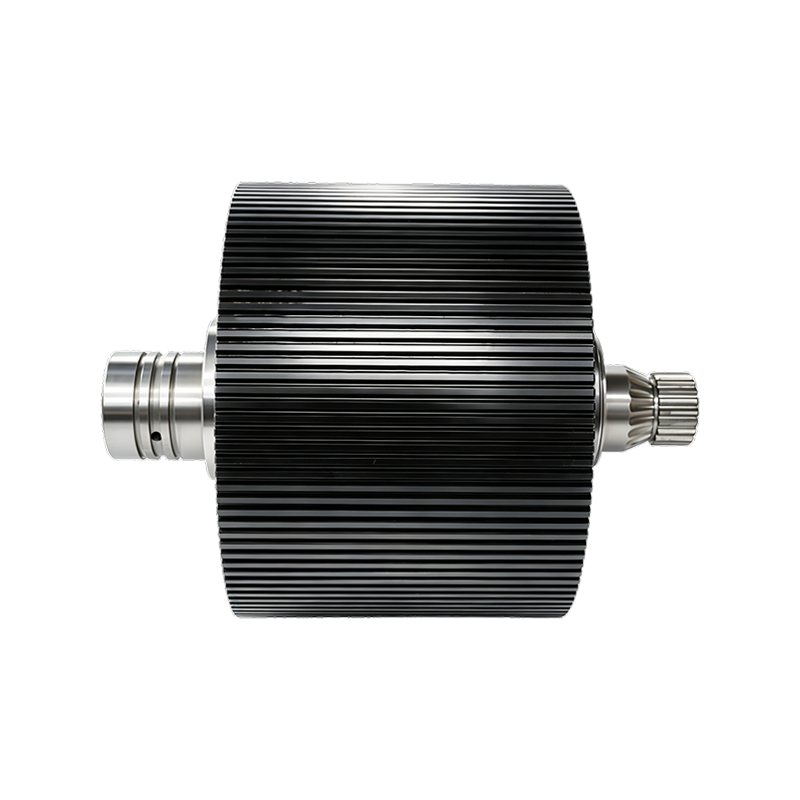
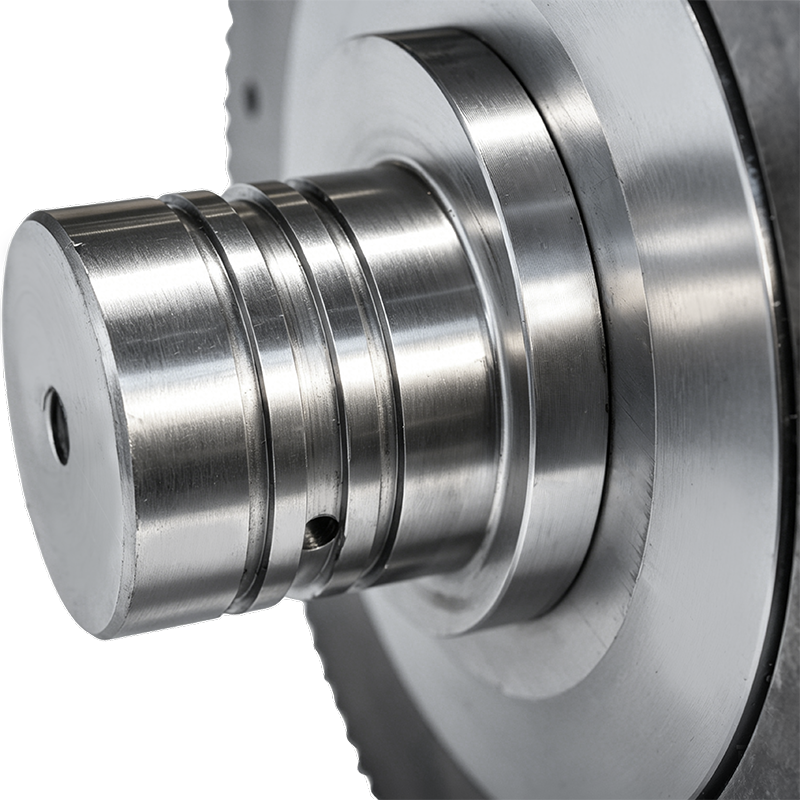 Complete Pellet Mill Roller Shell Assembly with Bearings and ShaftThis assembly bundles the roller shell, bearings, shaft, and sealing system into one unit, simplifying replacement and reducing downtime for continuous pellet production operations.View Product →
Pellet Mill Pressure Roller FAQ
These are the questions maintenance buyers ask most often when ordering pellet mill pressure roller parts.
How often should a pellet mill pressure roller be replaced?
In feed service, a correctly matched shell lasts roughly 1,000-2,400 hours. Wood lines with abrasive bark run toward the lower end, clean corn-soy rations toward the upper end. Inspect at every planned stop, and replace when the shell has lost 1.5-2 mm in diameter or shows spall pits.
What is the correct roller-to-die clearance on a pellet mill pressure roller?
Set the roller so it barely touches the die, then back off 0.1-0.3 mm. Verify the contact mark across the full shell width with the die stationary. A loose roller slips and heats; a tight roller flat-spots and cracks.
Can a worn pellet mill pressure roller shell be hardfaced and reused?
Hardfacing large flat-die rollers is occasionally practical, but on ring-die shells it rarely pays. Weld heat distorts the shell profile, and overlay thickness cannot hold the 0.1 mm tolerance needed for even pressure. A new 40Cr or 20CrMnTi shell costs less than rework plus downtime.
What hardness should a pressure roller shell have for feed pellets compared to wood pellets?
Feed mash is oily but less abrasive than wood. Most feed rations run well at 52-56 HRC in 40Cr. Wood pellets, carrying silica-rich bark and grit, prefer 58-62 HRC surfaces from 20CrMnTi or GCr15/100Cr6. Below 45 HRC, life drops sharply in either application.

Get In Touch
Follow us
Quick Links
Contact Us
Email : ysf@jindingsheng.com.cn
Address : No. 19, Qiucun Town Industrial Concentration Zone, Guangde City, Xuancheng City, Anhui Province
